You paid to have the wheels balanced. The shake was still there, so you went back and paid to have them balanced again. And you still feel it in the steering wheel somewhere north of 60, every time you get out on I-540 between Van Buren and Fort Smith.
That is one of the most frustrating things a driver can bring us, because on paper nothing is wrong. It is a cousin of the complaint we covered when a steering wheel sits crooked but the truck drives straight: the symptom and the measurement that explains it are two different things. The balancer said the wheels were balanced, and nobody is lying to you. A standard spin balance answers exactly one question, and the thing making your car shake at highway speed is usually the answer to a different one.
Here is what a conventional balance measures, what road force balancing in Fort Smith adds, and the other suspects a technician rules out before anybody talks about a new tire.
What a standard wheel balancing service actually measures
A spin balancer measures where the weight sits around the assembly. That is it. It spins the tire and wheel on a shaft, works out which side is heavier, and tells the technician how much weight to add and where, in two planes, so the heavy spot stops throwing the wheel off its axis. The tolerances are tight, too: most tire service professionals and factory service manuals agree residual static imbalance should not exceed about 0.30 ounces on an average size wheel, or 0.60 ounces on a larger light duty truck wheel.
Now notice what the machine never asks. It never asks whether the tire is round, or whether the tire is evenly stiff, or what happens once you set the weight of your car down on it. The tire is spinning in free air, carrying nothing. So when a balancer reads clean and your car still shimmies at 70, both things are true. The weight is where it should be. Something else is wrong.
What the load roller on a road force balancer adds
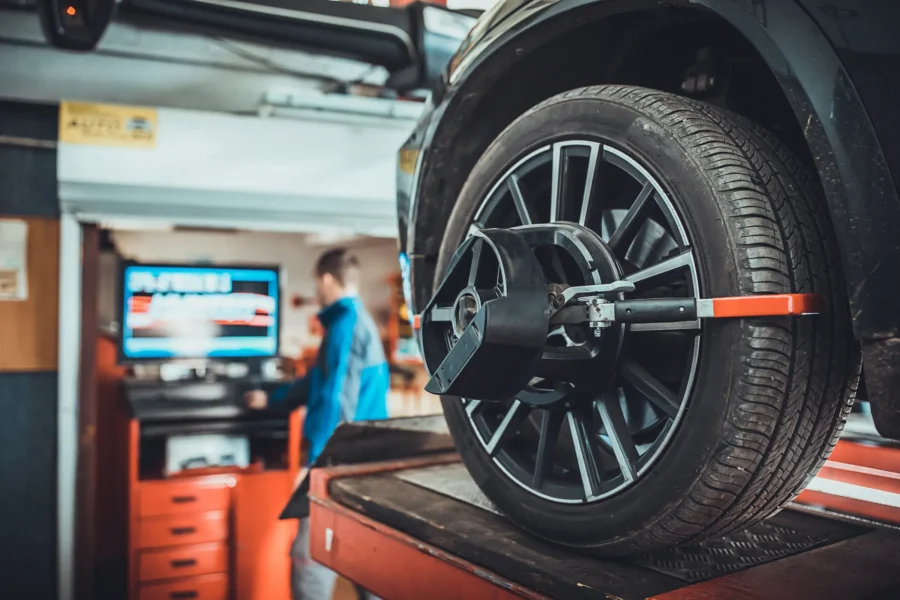
A road force machine is a balancer with one extra piece of hardware: a heavy roller that swings in and presses against the tire while it spins. On the Hunter GSP9700, the machine most shops mean when they say road force, that roller applies up to 1,400 pounds against the rotating assembly.
That is not a gimmick, it is a road test done in the bay. With the roller loaded, the machine sees two things a weight-only balancer never can: how much the assembly deflects up and down while squashed, and how stiff the tire is at each point around its circumference. Both in one spin.
Hunter’s own manual has the analogy that makes this click. Picture the tire as a ring of springs running between the rim and the tread. If those springs are not all the same stiffness, then as the tire rolls and flexes, the force it pushes into the axle rises and falls once per revolution. Round wheel. Balanced wheel. Axle still getting shoved up and down, once every turn.
That has a name, radial force variation, and it is not something a shop invented for a service menu. It is what tire plants measure under SAE practice J332: the variation of the load acting on the vehicle spindle while the tire is loaded. Until load rollers reached service bays, shops had no way to take it.
Why your car shakes at highway speed even though it’s round and balanced
The cleanest statement of the problem is Hunter’s own definition. Road force is the change in force between the wheel and the axle while rotating under a load, and a discrepancy in road force can cause a vibration although the tire and rim may be perfectly round and the tire is balanced. Read that twice, because it is the answer to why you have paid for two balances. Perfectly round. Perfectly balanced. Still shaking.
Fair question at this point: why can a technician not just check roundness with a dial gauge and skip the expensive machine? That used to be standard practice. It no longer works. Because manufacturers need very low uniformity numbers to keep vibration complaints down, more tire companies now grind or cut tires during production, shaving small areas of rubber from the sides and footprint of the tread to bring radial force variation into spec. That process, force grinding, fixes the force but may not improve unloaded runout at all, and sometimes makes it worse. So free runout, measured with the tire hanging unloaded, no longer indicates how an assembly behaves under load, and Hunter says plainly it should not be used to judge a tire’s contribution to a ride disturbance complaint.
There is a conversion that turns this into a number you can feel. On an average passenger car assembly, one thousandth of an inch of loaded radial runout is worth roughly one pound of road force, and MOTOR notes .010 to .015 inch of it, ten to fifteen pounds, is already enough to produce noticeable vibration.
Hunter put it on a dynamometer to prove the point. Testing a Chevrolet Lumina in a Detroit lab, technicians found 0.030 inch of loaded radial runout, about thirty pounds of road force, produced the same vibration as 1.5 ounces of wheel imbalance at 50 mph, and 0.75 ounces at 70 mph. Set that against the 0.30 ounce limit from earlier: at 70 mph that assembly was shaking the car as hard as two and a half times the maximum imbalance anybody would let out the door, and a weight-only balancer would have called it fine.
Reading the road force number: 26 pounds, 39 pounds, and why your car might care sooner
Road force comes out as a number in pounds, one per assembly, and shops work to a limit. The GSP9700’s default is 26 pounds for P-metric passenger tires and 39 pounds for LT light truck tires. Those defaults average recommendations from many OE vehicle and tire makers, and Hunter calls them conservative guidelines rather than verdicts, warning they should not be the only basis for replacing anything.
Vehicles are not equally fussy, which is the reason for that caution. Hunter notes an extremely sensitive vehicle can be affected by an assembly above 15 pounds, well under the default, and the machine can be programmed anywhere from 7 to 40 pounds on the radial first harmonic for exactly that reason.
So an assembly reading 18 pounds passes the standard 26-pound limit and gets handed back as good. On a sensitive car, 18 pounds is also a shake at highway speed. “It balanced fine” and “it still shakes” are not in conflict. They answer two different measurements, and only one was ever taken.
The other suspects a Fort Smith technician rules out
Road force is a diagnostic tool, not a verdict. It narrows the field rather than convicting the tire, and there is a list to work through before condemning anything.
- Air pressure, first. Hunter warns inflation must be set to specification before a road force measurement, because incorrect pressure changes the result. A measurement taken on a soft tire is not a measurement.
- The wheel itself. When the machine sees a force problem it prompts the technician to measure rim runout, then separates and displays the first harmonic contribution of the tire and of the rim independently. That is how a bent alloy from a Towson Avenue pothole gets identified instead of a brand-new tire getting replaced. As a general service guide, a tire should show less than .050 inch of radial runout, a steel rim less than .040 inch, an aluminum rim no more than .030 inch. Side-to-side limits run around .035 inch for steel and .020 inch for alloy, and on a sensitive vehicle as little as .008 to .010 inch can be felt.
- The hub. Hub runout measured at the lugs should not vary more than .030 inch. A hub out beyond that carries every wheel you bolt to it out of true, so rotating the tires chases the shake from corner to corner and never removes it.
- Debris packed inside the wheel. Mud off a Crawford County job site, or ice and slush packed into the inner barrel after a winter event, is unbalanced weight in the worst possible place, and the imbalance limit is only around 0.30 ounces. Around Fort Smith this is occasional rather than annual, which is exactly why nobody looks: the local snow record runs back to January 1884, the snowiest year on the books was 1921 with 22.6 inches, and some years have none at all.
- Whether braking changes it. This one is the discriminator, which is why a tech asks it early. Maximum allowable brake rotor lateral runout is only about 0.001 to 0.002 inch, and when a rotor exceeds it the pads lose consistent full contact with the disc face, so the symptom is a pulsating pedal under braking rather than a steady shake at cruise. Pulsation only when you brake sends the job to the brakes. A shake that is there at steady throttle, brakes untouched, sends it back to the rotating assembly and the hub above. Both at once means two separate repairs.
What can be fixed, and what means the tire is the problem
Here is the encouraging part: much of what road force finds can be corrected without buying anything.
The main correction is match mounting, which Hunter calls ForceMatching: breaking the tire loose on the rim and rotating it so the high spot of the tire’s radial force variation lines up with the low spot of the rim’s runout. The tire’s stiff spot and the wheel’s shallow spot cancel each other instead of adding up. Original equipment tire suppliers are required to mark a tire’s radial runout high point and OE wheel makers the wheel’s low point, and the dots on a new tire are part of that same system, red for the radial runout high point and yellow for the point of least weight. Done properly, match mounting can bring an assembly under the limit with no new parts, and often with less balance weight than before. One honest caveat: a small amount of force variation normally remains afterward, and that is expected. Unlike balance, this is not a number that goes to zero.
Beyond that, a bent wheel is straightened or replaced and a hub out of tolerance is repaired. Sometimes the measurement separates the tire from the wheel and the answer is that the tire’s own force variation is simply too high, in which case no amount of weight and no third balance will fix it. That is a tire problem, and possibly a warranty conversation, since the tire or wheel maker decides what counts as defective. Knowing which of those you are looking at is the entire value of the second visit.
What to tell us when you book it
The more you tell a technician up front, the less of your day gets spent reproducing something you already know. Have these ready when you call any of our three stores:
- The speed the shake appears, and whether it goes away above or below that speed.
- Where you feel it: steering wheel, seat, floor, or the whole vehicle.
- Whether braking makes it better, worse, or makes no difference.
- What has already been done, by whom, and how many times.
- How old the tires are, and whether the shake started with them.
- Any recent pothole or curb strike, and when the pressures were last set.
Loaded runout is a little unusual: it is often most noticeable at low speed, in the 5 to 30 mph range, then shows up again as ride roughness at 50 to 70 mph. So if your car shakes at highway speed and also feels lumpy pulling out of a parking lot, that is one clue, not two complaints.
We have been doing wheel balancing in Fort Smith, AR since 1963, with three River Valley stores to bring it to: Rogers Avenue and Towson Avenue in town, and Van Buren across the river. I-540 runs 14.7 miles from I-40 at Van Buren south through Fort Smith to the Oklahoma line, so we have real interstate to verify a fix on instead of a lap around the block. If a balance has been done twice and the shimmy is still there, the next step is a loaded measurement, not a third round of weights.
Bring it in and let us put a number on it. We will not quote a vibration diagnosis in a blog post, because parts and labor prices move around too much for that to stay honest. Request a quote instead, tell us what you feel and at what speed, and we will give you a current price along with what it takes to make the shake go away.