You’re heading up I-540 toward Van Buren, the road is flat and dry, and the truck is holding its lane on its own. Everything is fine except for one thing. The logo on the steering wheel hub is sitting a few degrees off. Not enough to fight. Just enough to notice, every time you get in.
Most drivers file this under cosmetic. The wheel got put on crooked at the factory, or somebody bumped something, and since the vehicle drives straight it must not matter. That reading is wrong, and it’s one of the more common misunderstandings we hear in our bays. A vehicle that tracks straight with a steering wheel off center isn’t a vehicle with no problem. It’s a vehicle telling you exactly what’s wrong, in the only language it has.
The surprising part is where the fault usually lives. Not in the steering wheel, not in the tie rods, not anywhere in the front end at all. It’s almost always at the back of the vehicle, and that one fact decides which kind of wheel alignment Fort Smith drivers actually need to ask for.
What a steering wheel off center is actually reporting
Start with what “straight” means to a technician. The industry term for a straight and level steering wheel position while the vehicle rolls down a straight road is centerline steering. That’s the finish condition every alignment should end in. If a vehicle leaves a rack tracking true and the wheel isn’t level, the job isn’t done.
So if your vehicle goes straight but the wheel rests crooked, something is forcing the front wheels to sit turned slightly while the vehicle travels in a straight line. They’re pointed where they have to be to cancel out something else, and that something else is the rear axle.
The rear axle is steering your vehicle and you can’t see it doing it
Every vehicle has a geometric centerline running front to back through its middle. It also has a thrust line. Thrust angle is an imaginary line drawn perpendicular to the rear axle’s centerline, compared against the vehicle’s own centerline. In plain terms, it’s the direction the rear wheels are aimed versus where the body is pointed. When those two lines lie on top of each other, thrust angle is zero, the ideal, and the front wheels can sit dead straight ahead.
Let the rear wheels drift a fraction off and the back of the vehicle starts pushing at a slight diagonal. Now the front wheels have to steer into that push to keep the vehicle going where the road goes. Free ASE Study Guides offers an analogy anyone who has run a forklift will get: point the rear tires to the left and the machine steers to the right.
Your truck does the same in miniature, so slightly you never feel it. The front wheels take up the correction, the vehicle tracks straight, and the steering wheel, which is bolted to the shaft that turns those front wheels, comes to rest a few degrees off center. An improper thrust angle makes the front wheels steer into the rear axle’s direction, leaving the wheel crooked even when the driver isn’t turning at all. That’s the whole mechanism. The rear is aimed wrong, the front compensates, and the steering wheel is the gauge that reports it.
What else a thrust angle problem does while you ignore it
An off-center wheel is annoying. The rest of what comes with it costs you money.
- Tire wear. A thrust angle off zero drives increased tire wear, and toe-related wear has a signature: a feathering pattern across the tread, angling one direction for toe-in and the other for toe-out. Run your palm across the tread and it feels smooth one way and sharp the other.
- Dog-tracking. With the rear pushing at an angle, the body sits crooked relative to the direction of travel. It’s the look you’ve seen on an older trailer going down Rogers Ave, where the back doesn’t quite follow the front. It also leaves the vehicle turning differently left than right.
- Driver-assist trouble on newer vehicles. More than 60 million vehicles on the road carry ADAS components, and 96% of 2020 model-year vehicles came with at least one driver-assist function. Those cameras and radar units aim relative to where the vehicle actually goes.
Hunter Engineering puts it directly: the key measurement is the thrust line, not the center line, and it’s impossible to find the thrust line outside of an alignment rack. A camera or radar unit a half-degree off becomes five feet off at 200 yards.
Why a front-end alignment can’t fix this
A two-wheel or front-end alignment adjusts the front wheels against the vehicle’s geometric centerline. It doesn’t look at the rear at all. If a technician wants your steering wheel level and only has the front to work with, the tempting move is to set the wheel straight and split the correction across the front tie rods.
For a few weeks, that looks like a fix. It isn’t one. The rear is still pushing at an angle, so the front wheels are now set wrong relative to the direction the vehicle is actually traveling, and both front tires scrub across the pavement for every mile you drive. The crooked wheel comes back, and the tires are worse off than when you started. MOTOR describes centerline two-wheel alignment, which ignores rear wheel position and thrust direction entirely, as a method that should now be considered obsolete.
Here’s what catches even careful owners off guard. Plenty of vehicles have a rear axle with no adjustment at all, and owners conclude a four-wheel alignment is pointless on their truck. It’s the opposite. Even when the rear axle is non-adjustable, the rear readings still have to be taken in order to align the front suspension properly, because those readings are the reference the front gets set to. Skip them and you can undermine even the most accurately aligned front suspension.
Non-adjustable in back doesn’t mean skip the measurement. It means the measurement is the only thing telling the technician where straight ahead really is. So when you go looking for an alignment shop near you, the question worth asking on the phone isn’t what it costs. It’s whether all four wheels get measured.
What a four-wheel alignment measures and adjusts, in order
When your vehicle goes on the rack, the sequence matters as much as the numbers.
- Test drive first. The technician drives it to feel the actual complaint: the pull, the vibration, the off-center wheel.
- Load the factory specs. Every model has its own factory targets, pulled up before anything is touched.
- Inspect with the wheels hanging. Tires, steering, and suspension components get checked for damage and wear. A worn part won’t hold an alignment no matter how well it’s set.
- Set tire pressures to factory spec. Pressure changes ride height and the readings with it, so adjusting after measuring means the numbers were never right.
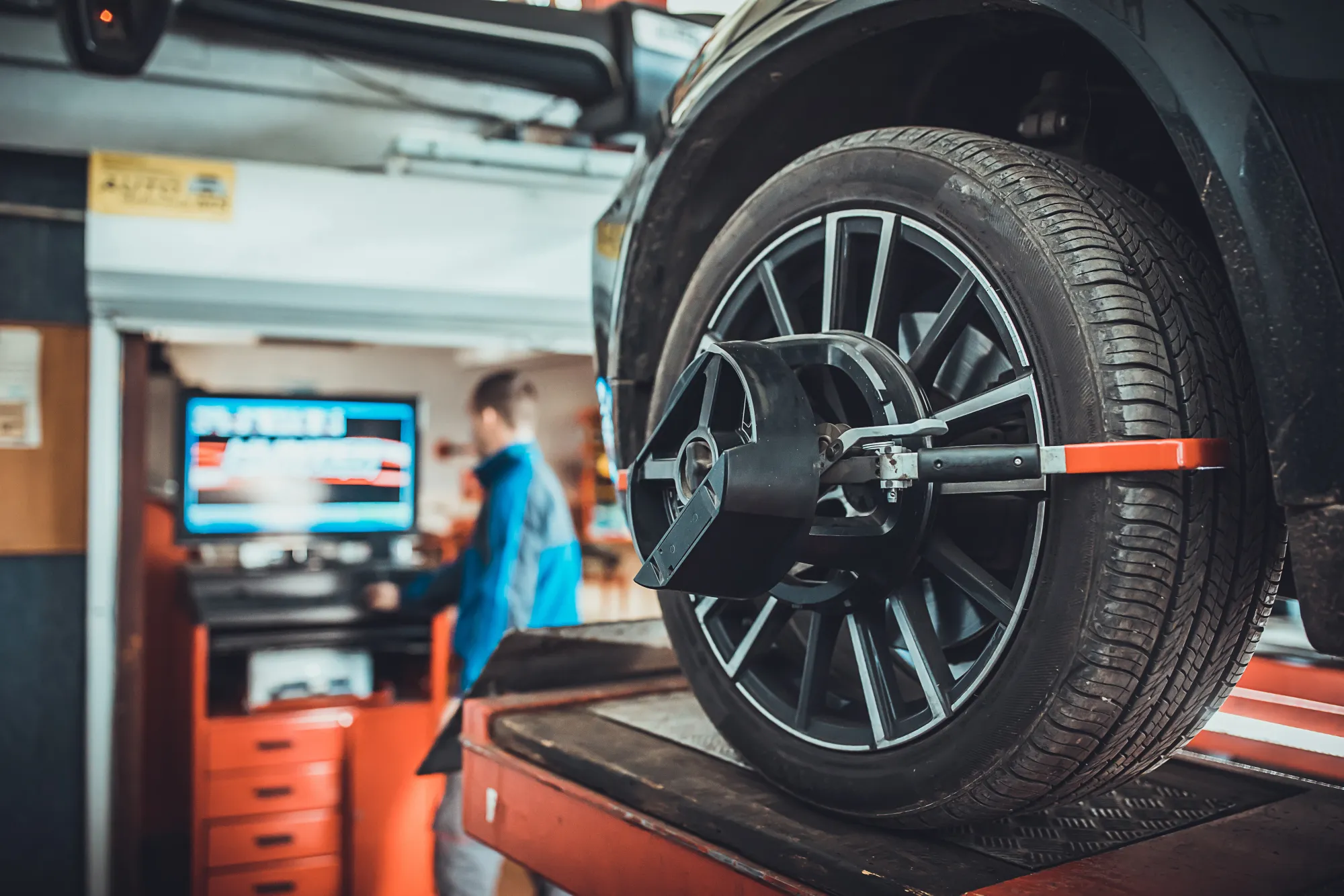
- Mount the targets and measure. Camber, caster, and toe get read at all four corners, and thrust angle gets read to see where the rear is actually aimed.
- Adjust the rear first. The rear establishes the reference. Whatever happens up front is set against it.
- Front caster and camber, then toe last. Toe changes when camber and caster change, so toe is always the final adjustment.
- Re-center the steering and recheck. The wheel gets locked at center, the angles get verified, and the vehicle gets driven again to confirm the complaint is gone.
Which version of the job your vehicle gets depends on the rear suspension. When rear toe is adjustable, the correct service is a total four-wheel alignment, where the rear itself gets brought back toward straight. When rear toe isn’t adjustable, the correct service is a four-wheel thrust-line alignment: the rear gets measured, the thrust line gets established, and the front wheels get set parallel to it with the steering wheel locked at center. Either way the goal is getting thrust angle as close to zero as the vehicle allows, and either way the wheel ends up level.
When to ask for a four-wheel alignment
You don’t need to wait until something is visibly wrong. Ask for one when:
- You put on new tires. New tread on a bad thrust angle starts wearing wrong immediately.
- Any suspension or steering component gets replaced. Control arms, tie rods, springs, shocks, and bushings all move the angles.
- You install a lift or leveling kit. Lifting changes geometry enough that factory control arms can lose the range to handle the clearance and alignment changes, which is why aftermarket performance arms exist to restore camber and caster on a lifted truck. A ball joint can also bind at the lifted angle. This is required work after a lift kit install, not optional work, and if you bought the truck with the lift already on it, our walkthrough of what a Fort Smith shop checks first on an already-lifted truck covers the rest of that inspection.
- You hit a pothole or a curb hard. Rear toe drifts from impacts like these, a common cause of a crooked wheel on a vehicle that was fine last month.
- The steering wheel sits off center, or the vehicle pulls. Both are symptoms worth measuring.
- After the alignment, on a newer vehicle, ask about ADAS. Hunter Engineering reports that 11 of 28 manufacturers require a driver-assist calibration following a wheel alignment, including Ford, Volkswagen, Jeep, Kia, Dodge, and Subaru.
What a rack can fix, and what has to be repaired first
An alignment rack adjusts angles. It doesn’t straighten bent metal, worth knowing before you book.
Some crooked-wheel vehicles have a mechanical problem underneath the alignment problem. On a solid rear axle, a broken leaf spring center bolt or a failing shackle lets the axle shift out of square with the front, and no amount of adjustment will hold until that hardware is replaced. On an independent rear suspension, the correction is a rear toe link adjustment. On trailing-arm setups, worn or damaged bushings or a bent arm can produce a genuine pull. An axle toe difference greater than 0.50 degrees is a flag to go looking for a bent axle housing rather than to keep turning adjusters. Collision history matters too: impact damage and rear-end repairs that weren’t done squarely are among the most common causes of a thrust angle that won’t come back to zero.
That’s why the inspection comes before the adjustment, and it’s why we don’t put a number on this job over the phone. Until a technician has the vehicle up and has read the angles, nobody knows whether you’re looking at an alignment, an alignment plus a bushing, or a repair that has to happen first. When you’re ready for real numbers on your vehicle, request a quote and we will price exactly what it needs.
Wheel alignment in Fort Smith and Van Buren
River Valley roads are hard on rear toe. Freeze-thaw seasons open up pavement, patched shoulders and construction detours do the rest, and a single hard hit on a back road outside Greenwood or Barling is all it takes to nudge a rear axle a fraction off. It’s rarely one dramatic event, more a season of small impacts adding up to a wheel that no longer sits level.
Work trucks and fleet vehicles feel it first, because they cover the miles. A crew truck running Fort Smith to Van Buren all week will show feathered tread long before a commuter car will. If you run several vehicles, put alignment checks on the same schedule as regular tire rotations rather than waiting for a driver to complain.
We’ve been aligning vehicles in this corner of Arkansas since 1963, at three locations: Fort Smith on Rogers Ave, Fort Smith on Towson Ave, and Van Buren. Some of what comes through is a straightforward four wheel alignment in Van Buren, AR after a new set of tires. Some of it is a full inspection on a truck that has been fighting a crooked wheel for a year. Either way, we measure all four corners and tell you what we find before we touch an adjuster.
Bring it in and let us measure it
If your steering wheel is off center, don’t let anyone straighten it at the tie rods and send you on your way. Get the rear measured. That’s the difference between fixing the problem and buying front tires sooner than you should.
Stop by whichever of our three Fort Smith and Van Buren stores is closest, or request a quote for a four-wheel alignment on your vehicle. We will read the angles, show you the numbers, and give you a straight answer on what it takes to put that wheel back where it belongs.