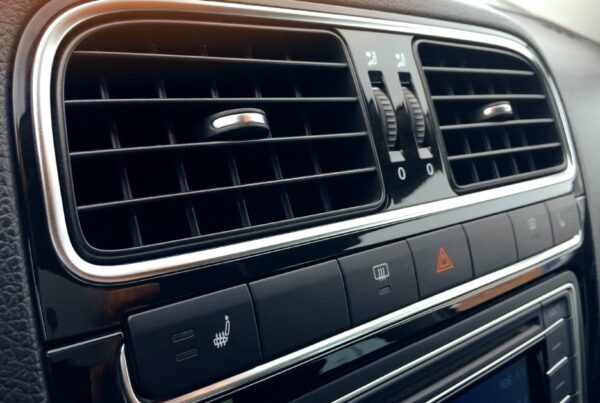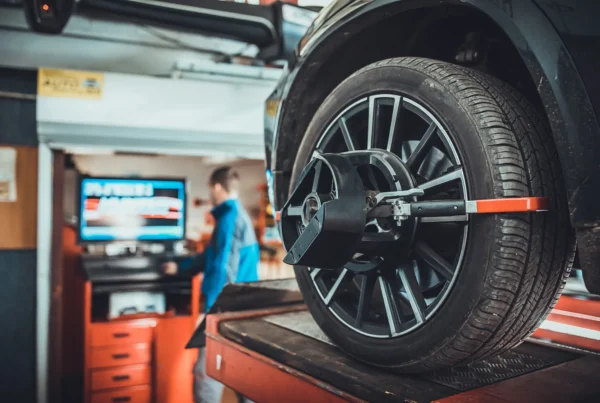

You came in for four new tires. You picked a set, the truck went up on the rack, and the job went fine. Then you started it in the parking lot and there it was: the little horseshoe with the exclamation point, glowing at you from the dash.
The first thought is almost always the same. Somebody didn’t air them up right.
Nine times out of ten, that isn’t what happened. The tires are new. The sensors are not. Every tire on your vehicle has a small electronic device bolted to the inside of the wheel, and that device runs on a battery you cannot change. It went in years ago, it has been transmitting ever since, and the week you buy new tires is very often the week it finally gets asked a question it can no longer answer.
What Is Actually Inside Your Wheel
The system is called TPMS, short for tire pressure monitoring system. On most vehicles it puts a sensor in each wheel. That sensor is not a gauge on a wire. It is a sealed radio transmitter, usually mounted at the base of the valve stem, and it reads the air pressure inside the tire and broadcasts that reading to a receiver in the vehicle.
To broadcast, it needs power. No wire runs to the inside of a spinning wheel, so each sensor carries its own battery, sealed inside the housing when it was built.
The Tire Pressure Sensor Battery Is Sealed In for Life
According to REDI-Sensor, a division of Standard Motor Products, most TPMS sensors run on batteries that are built into the sensor and are not replaceable. When the tire pressure sensor battery runs down, the entire sensor assembly gets replaced, because the battery and the sensor are one sealed part.
The same source puts the life expectancy of the lithium ion battery in a TPMS sensor at anywhere from 5 to 10 years. A 2014 work truck still wearing its factory sensors is living on borrowed time, whether the dash has said anything yet or not.
Why the TPMS Light Shows Up the Week You Buy Tires
Sensors and tires share a birthday more often than you would think. If your sensors are the originals, they went in the day the vehicle was built. If they were replaced when an earlier set of tires was mounted, they all went in that day. Either way, all four are the same age, and their batteries are draining on roughly the same schedule.
Then a tire purchase comes along. The wheels come off and the tires get dismounted, which is the first time in years anything has handled the sensor and the first time a technician has interrogated it with a tool to see whether it still answers. A sensor that had been fading quietly, reporting now and then and getting ignored, suddenly has to hold a conversation on demand.
That is why a TPMS light after new tires is so common, and why it so rarely means the installation was botched. The tire purchase did not break the sensor. It just happens to be the event that reveals a sensor already at the end of its service life.
Here is the version we see at the counter on Rogers Avenue. A ten-year-old pickup comes in for a fresh set. The tires mount up clean, the pressures are dead on the placard, and the light still comes up at startup, because two of the original sensors have run their batteries down. The truck just told the truth for the first time in a while. It does not help that Fort Smith swings from a July high around 93 degrees to a January low around 29, so anything living inside a wheel here heats and chills hard every year.
Solid Light or Flashing Light: Two Different Messages
Watch the dash for the first minute and a half after you start the engine, because the pattern is the diagnosis.
- Solid from the start, and it stays solid. This usually means what everyone assumes. One or more tires is genuinely low and needs air back to the door placard pressure.
- A flash for 60 to 90 seconds, then solid. Per REDI-Sensor, that pattern signals a problem with the TPMS system itself, most likely one or more sensors not communicating with the vehicle: a damaged sensor, a missing sensor, a depleted battery, or an incompatible sensor installed in the tire.
That second pattern is the one that shows up after a tire purchase on an older vehicle. The system is not reporting low pressure. It is reporting that it cannot get a reading at all.
This is also why the gas station air hose never fixes it. A customer adds air, watches the light stay on, and decides the new tires were installed wrong. The pressures are correct; the vehicle is telling you it lost contact with a sensor. No amount of air clears that, because air was never the problem.
Both messages exist because federal law requires both. Under Federal Motor Vehicle Safety Standard No. 138, the low tire pressure telltale must illuminate no more than 20 minutes after pressure in one or more tires falls to 25 percent below the manufacturer’s recommended cold inflation pressure. Separately, the standard requires a telltale that warns the driver no more than 20 minutes after a TPMS malfunction occurs. It covers cars and light trucks rated at 10,000 pounds gross vehicle weight or less, excluding vehicles with dual wheels on an axle, and full compliance was mandatory for vehicles built from September 1, 2007 onward.
So if your vehicle is a 2008 or newer car or light truck, it is legally obligated to tell you when its own monitoring system has quit.
How a Shop Tells a Dead Sensor from a Real Leak
- Check the actual pressures with a hand gauge. All four tires get measured against the door placard before anything electronic gets involved. That separates a true low tire from a system complaint.
- Interrogate each sensor with a TPMS tool. The tool triggers each sensor and reads back its ID, pressure, temperature and battery condition. If the gauge says placard pressure and the sensor reports something far off, the sensor is lying, not the tire. One that will not answer at all has failed.
- Look for the leak if the tire really is low. It gets dismounted and checked: the bead area, the tread and sidewall, the wheel for corrosion, and the valve core and stem.
- Confirm which corner is which. A sensor ID reporting from the wrong position points at a relearn that never got finished after a rotation or wheel swap.
Why It Cannot Just Be Reset or Turned Off
Every shop that services tires gets this request: just turn the light off.
We understand the impulse, and the honest answer is that we are not permitted to. The federal make inoperative provision prohibits repair businesses from knowingly making inoperative, in whole or in part, any device or element of design installed on a vehicle in compliance with a federal motor vehicle safety standard. TPMS is exactly that kind of device.
NHTSA has addressed the case of a sensor that is already dead. Removing a malfunctioning TPMS sensor integrated with a valve stem does not violate that provision, because the element was already inoperative. But the agency was clear about the next step: a repair business that goes on to make any other element inoperative, for example by disabling the malfunction indicator lamp, would violate it.
A dead sensor can come out, but the warning lamp is not ours to kill. A “reset” cannot fix a failed sensor anyway. Resetting tells the system to look again; if the battery is gone, the system looks, finds nothing, and lights the lamp right back up. The only real repair is a new sensor, installed and relearned.
What a Relearn Procedure Is, and Why It Is a Shop Step
A new sensor has its own unique ID. Until the vehicle is taught that ID and which corner it lives in, it will not trust the sensor. That teaching step is a relearn, and there are three ways it happens.
- Auto relearn. No tool needed, but the vehicle has to be driven for a period of time before the light goes out.
- Stationary relearn. No driving, but a TPMS activation tool puts the vehicle in learn mode and triggers each sensor in sequence so the system knows which one sits at which wheel.
- OBD relearn. A TPMS scan tool connects to the diagnostic port and writes the new IDs into the vehicle’s module, sometimes followed by a short drive. One published example calls for driving at 12 mph for up to five minutes.
Two of the three need equipment that does not live in a glovebox. Bartec USA, which builds TPMS tools for the trade, breaks the market down as roughly 39 percent auto learn, 36 percent OBD relearn and 25 percent stationary relearn, and notes that a growing number of vehicles require a scan tool to finish a TPMS repair at all.
Relearns matter beyond sensor replacement. Move sensors to new positions during a rotation and many vehicles need one afterward so the display names the correct wheel. Put a set of aftermarket wheels on a truck and the sensors either transfer over or get replaced, then have to be relearned to the right corners. Otherwise the dash eventually warns you about the wrong tire.
Why the Valve Stem Hardware Gets Replaced Every Time
When a tire comes off a TPMS-equipped wheel, the small parts around the sensor get replaced as routine: the nut, the washer, the seal or grommet, the valve core, and the valve cap, usually sold as a kit.
That is not padding. According to REDI-Sensor, those parts are designed for one-time use only, and replacing all of them is what ensures the sensor seals properly against the wheel. Reusing them invites corrosion of the metal parts, driven by road grime, road salt, and the bimetallic reaction between the fitting and the wheel. A compromised valve stem can also cause air leakage and incorrect pressure readings, so a tired grommet can generate the exact symptom you came in to solve. The metal valve stem itself is reusable unless it is damaged.
The grommet does the hardest work. It is the gasket between the stem and the hole in the wheel, squeezed under load through every heat cycle, and once it has taken the shape of that rim it is a used part.
TPMS Sensor Replacement in Fort Smith: One Sensor or All Four?
Replacing the single failed unit gets the system working today. But REDI-Sensor makes the practical point that when a failure comes from a dead sensor battery, the others are likely close behind, since they are the same age and have done the same work. Some drivers would rather do all of them while the tires are already off the wheels than come back in a few months for the next one.
What usually decides it is your vehicle’s age, how long you plan to keep it, and whether the wheels are already apart for other work. For what TPMS sensor replacement in Fort Smith would involve on your specific vehicle, ask us for a current quote rather than trusting a number you read online, because parts and labor vary by make and model and they change over time.
What to Do If Your TPMS Light Is On
- Watch the startup pattern. Solid from the start points toward air. A flash, then solid, points toward the system.
- Check all four tires with a gauge, cold. The placard in the driver’s door jamb has your numbers, not the number molded into the sidewall, which is a maximum.
- Air them to spec and drive. If the light clears and stays clear, you had a low tire. Keep an eye on that corner, because a tire that went low once is usually losing air for a reason.
- If the light stays on, or comes back, bring it in. At that point it needs a tool, not a hose.
Talk to a Tire Shop in Fort Smith, AR That Will Show You the Readings
Jim Grizzle Tire has been a family-run tire shop in Fort Smith, AR since 1963, with stores on Rogers Avenue and Towson Avenue plus our Van Buren location, and TPMS work is a normal part of any tire job we do. If your light is on, if it came on right after a new set went on, or if you just want to know where your sensors stand before you buy tires, stop by the store closest to you or request a quote and tell us your year, make and model. We will tell you what your vehicle is reporting, and what it will take to make the dash quiet honestly.